
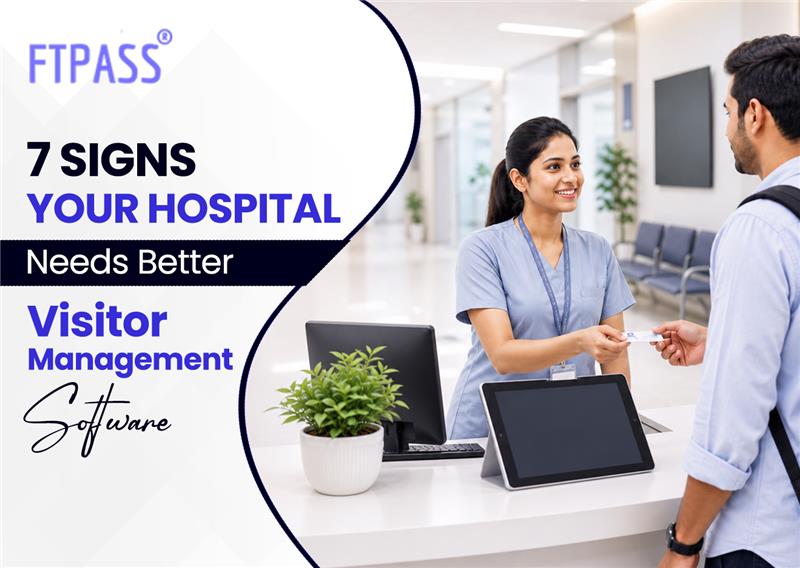
7 Signs Your Hospital Needs Better Visitor Management Software
Walk through the lobby of almost any hospital during visiting hours, and you'll likely see the same scene. A queue at the reception desk. A security guard checking names in a paper log. Family members anxiously trying to explain which ward they're visiting while staff juggle multiple tasks at once.
It's not that anyone intentionally designed the process this way. Over time, outdated systems simply became the norm, with small workarounds masking bigger inefficiencies. But as patient volumes grow and security expectations increase, those gaps become harder to ignore.
If this sounds familiar, it may be time to move beyond temporary fixes and invest in a smarter, more efficient solution like hospital visitor management software.
1. Your Front Desk Is Always Backed Up
When visiting hours regularly create long queues at reception, the issue isn't necessarily a lack of staff. More often, it's an outdated process. Manually recording visitor details, calling wards to confirm patients, and issuing handwritten visitor passes all take valuable time. During peak hours, those small delays quickly add up, creating congestion for visitors and extra pressure on hospital staff.
Hospital visitor management software streamlines the entire process. Visitors can check in by scanning a QR code or using their mobile device, completing registration in seconds. That means shorter queues, faster access, and more time for hospital teams to focus on what matters most instead of managing paperwork.
2. You Can't Say Who's in the Building Right Now
Ask yourself honestly, if there were a fire alarm this minute, could your team produce an accurate list of every visitor currently inside? For a lot of hospitals, the answer is no, or not quickly. Paper logs and disconnected spreadsheets make it nearly impossible to get a real-time picture, which is a serious gap. This isn't just an operational inconvenience. In a building where evacuation planning matters, it can directly affect safety and emergency preparedness.
3. Restricted Wards Aren't Actually Restricted
ICUs, maternity wards, psychiatric units, and isolation rooms need tighter control than a general visiting area, but plenty of hospitals still rely on a guard's memory or a printed list taped to a wall. That's not reliable. Hospital visitor management software can flag restricted zones automatically and alert staff the moment someone tries to enter an area they're not cleared for.
4. Infection Control Screening Is an Afterthought
Temperature checks and basic health screening have become a standard part of visitor management in many healthcare facilities. Yet, many hospitals still rely on manual processes, with staff recording information on paper and asking screening questions at the entrance. During busy periods, it's easy for steps to be missed or questions to be overlooked. A digital check-in system integrates health screening into the registration process, ensuring every visitor completes the required checks consistently while reducing the burden on reception staff.
5. Staff Have No Idea Who to Expect
When visitors arrive without prior notice, reception staff often have to contact the relevant ward to confirm the visit before granting access. This can interrupt doctors and nurses during patient care, create delays at the entrance, and slow down the entire process. A modern visitor management system gives hospital staff advance notice of expected visitors, including when they're arriving and which patient they're visiting, allowing visits to be verified and managed with minimal disruption.
6. Records Are Scattered Across Different Systems
Some hospitals still juggle a mix of paper logs at one entrance, a spreadsheet at another, and nothing at all for staff and vendor entries. When an incident happens, whether it's a complaint, a security concern, or just an audit, pulling accurate records becomes a difficult task across departments. Centralized software keeps every entry point's data in one searchable place.
7. Compliance Requests Take Forever to Fulfil
Healthcare facilities face regular audits, and being asked to produce visitor logs from three months ago shouldn't mean digging through a storage closet. When compliance requests consistently consume hours of staff time, it's often because your documentation process wasn't designed to handle the volume of records hospitals are expected to maintain today.
What Better Software Actually Looks Like
The good news is that you don't have to transform your entire operation overnight. Many hospitals start by implementing a visitor management system at their busiest entrance, fine-tune the process, and gradually roll it out across the facility. The benefits become noticeable almost immediately: shorter wait times, fewer visitors getting lost, and fewer interruptions for doctors and nurses who no longer have to step away from patient care to assist with visitor enquiries.
Conclusion
None of these seven signs are dramatic on their own. A long queue of visitors at the reception, a scattered spreadsheet, a screening step that sometimes gets skipped- each one seems manageable in isolation. Individually, these challenges may seem manageable.
Together, they reveal a larger issue: many hospitals are still relying on processes that were never designed for the demands of today's healthcare environment. Hospital visitor management software won't solve every operational challenge, but it can eliminate many of the gaps that paper-based systems and manual processes simply can't address.
Frequently Asked Questions
What is hospital visitor management software?
It's a digital system that manages check-in, screening, ward access, and record-keeping for anyone entering a hospital, replacing manual logs and paper passes.
Can hospital visitor management software handle restricted areas like ICUs?
Yes, access rules can be set per ward, and staff get alerted automatically if someone tries to enter a restricted zone.
Can hospital visitor management software handle emergency visitor access?
Yes. Modern hospital visitor management software is designed to support emergencies by allowing fast, authorized access while automatically logging visitor information for security, compliance, and future reference.
Will visitors need to download an app to use it?
Most systems work through a QR code, so visitors don't need to install anything on their phones.